Business
Data Hub.
Connected reports. Organized records. A clear path back to the source.
Business software / Built by AstucoreFollow the data.
Keep the context.
Explore the workspace, inspect a record, and follow it back to the original source. These are actual application screens with synthetic test data.
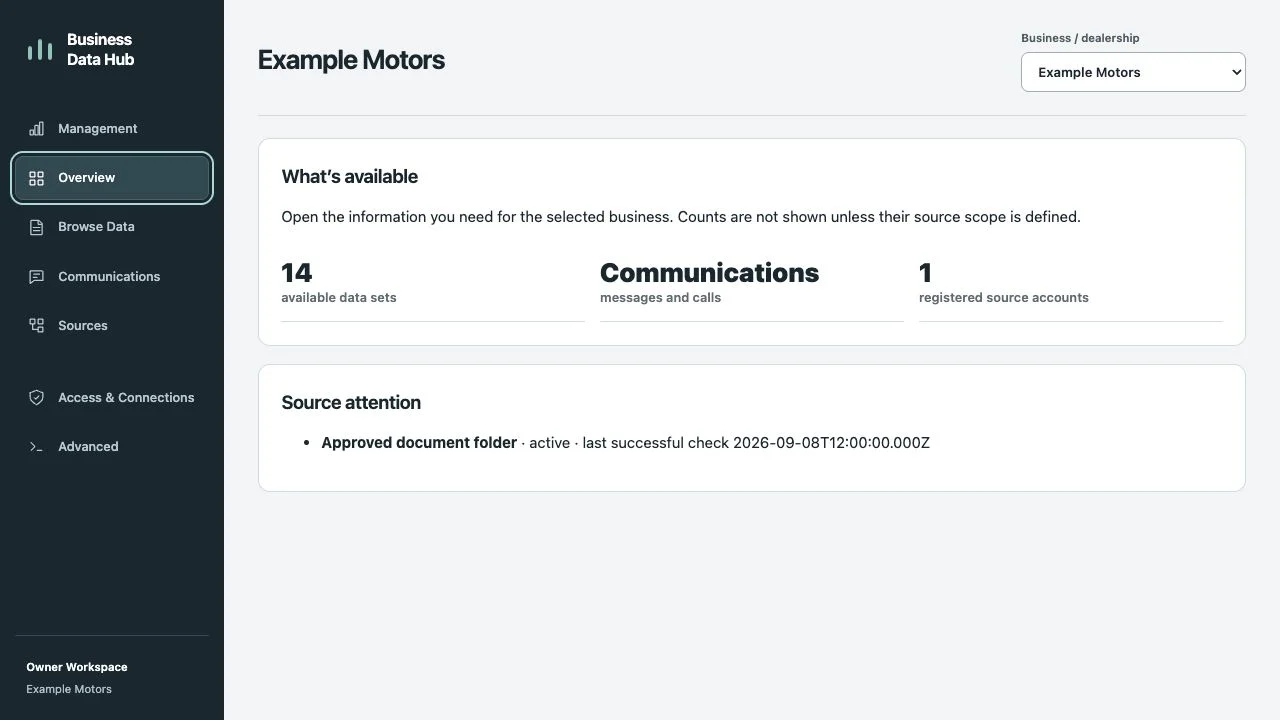
See what is available.
Choose a business and see the available data sets and source attention in one workspace.
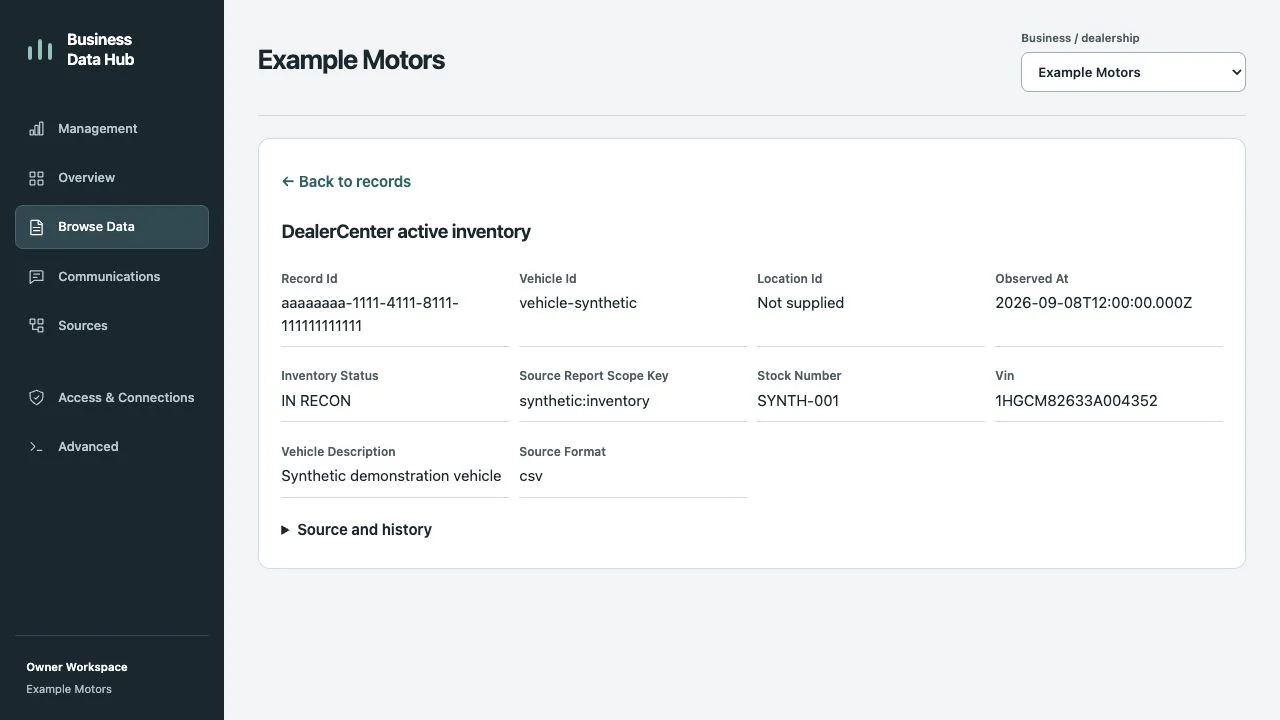
Inspect the record.
Open a record to inspect its status, source scope, observation date, and supplied fields. Missing information stays visible.
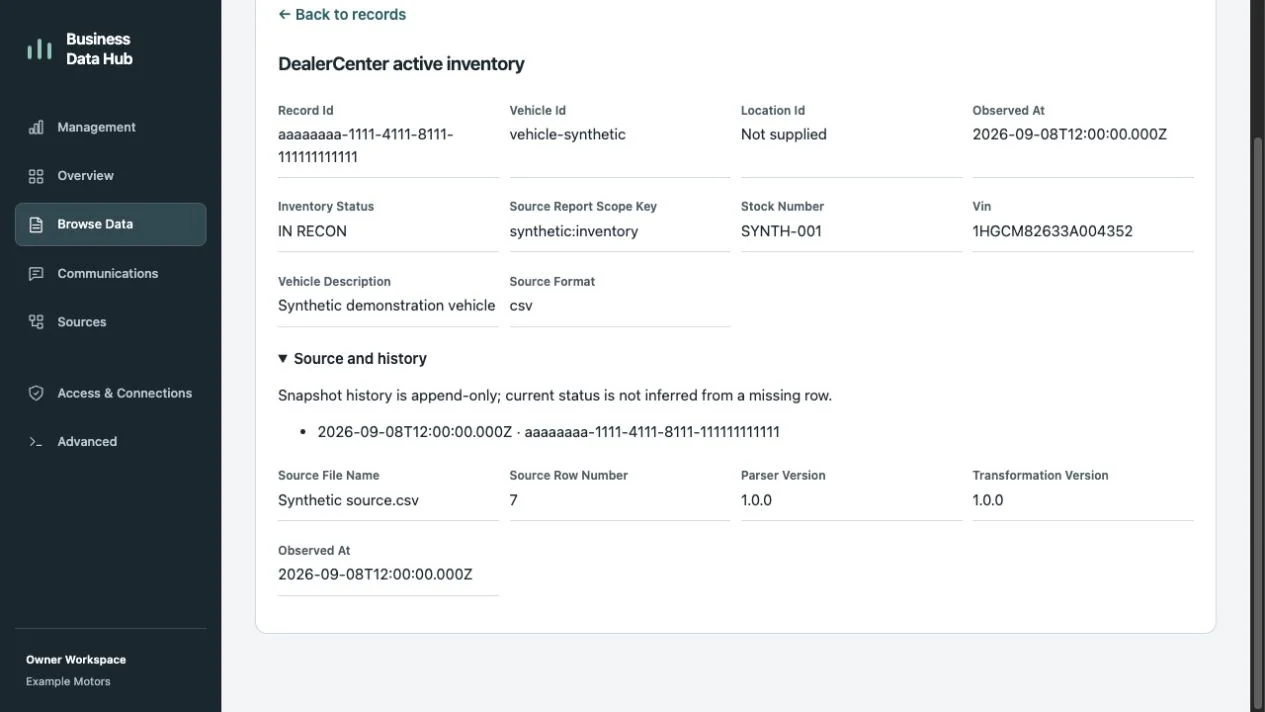
Follow it to the source.
Expand source history to see the original file, row, and transformation version behind the record.
Actual application interface · Synthetic test data · Select a step to explore
The report is
only the start.
A file arriving is one event. Making its information useful, traceable, and available to the right application is a complete workflow.
Business Data Hub was built to connect reports from different systems without losing the original file or the history behind a record. It gives incoming information a shared structure while keeping the source systems responsible for their own data.
The project brings together report intake, original-file archival, consistent record formats, observation history, and delivery tracking. Connected applications read through a controlled interface rather than each building a separate report-import process.
It is a data foundation. It does not replace the CRM, accounting software, or other systems a business already uses.
From a file
to a useful record.
Preserve the original
The source file is archived before processing. A later interpretation does not overwrite the original material, so a person can return to the evidence behind a value.
Organize without erasing context
Incoming fields are organized into consistent records. The observation date, source scope, and supplied values remain part of the record. Missing information stays visible rather than becoming an invented answer.
Keep the history connected
A record can be traced to its source file, row, and transformation version. That matters when a report changes, an import needs review, or two systems appear to disagree.
Make the next application simpler
Applications use scoped access to the organized information. The shared foundation handles intake and source history, while the consuming application focuses on the task its users need to complete.
One successful feed
is not the whole picture.
Delivery is tracked by report feed, against its configured schedule and latest accepted source receipt.
A successful report from one source should not hide a missing report from another. Business Data Hub distinguishes received, awaiting, late, and invalid-schedule states so the next investigation starts with the affected feed.
Receiving a report also does not prove that it covers the entire current business. Observation time, missing information, and source limits still matter. An item disappearing from a report is not automatically evidence that it was sold, closed, or otherwise resolved.
Plan a complete automation workflowThe details
are the point.
A dashboard is easier to trust when its records can explain where they came from.
- Original source files kept separately from interpreted records
- Consistent fields with source scope and observation history
- A visible route from a record to its source file and row
- Delivery status for each configured report feed
- Controlled reads for connected applications
The walkthrough demonstrates those design choices. Its fictional records are for presentation; no customer data is shown. This project example does not claim measured time savings or a return on investment for another business.
Before a
similar build.
Can this approach connect our existing tools?
The starting point is a review of your reports, APIs, formats, access, and update schedules. The connection must fit what each provider actually supports. A file import, API integration, or focused application may be the right first step.
Does a data workflow need AI?
Not necessarily. Known formats, fixed rules, and scheduled handoffs can often be handled with ordinary software. AI may be useful for less structured inputs, but its output needs evaluation and an appropriate review path.
What should we bring to a first conversation?
Describe one repeated reporting task, the source systems, who uses the result, and how the current handoff works. Identify the exceptions and the result you would accept. Do not include live customer records or credentials in the initial inquiry.